Global acceptance and deployment of Battery Energy Storage Systems (BESS) accelerates with every quarter. Placing sensitive lithium-ion cells and power electronics in harsh outdoor environments has become standard practice.
However, such conditions demand reliability, which in turn relies on a single critical factor: the enclosure’s ability to repel nature.
What are IP Ratings?
Ingress Protection (IP) ratings are the first line of defense against catastrophic failures, thermal runaway risks, and warranty voids. For anyone considering BESS deployment, understanding the nuance of enclosure protection is vital. A misunderstood rating can lead to moisture ingress, which accelerates corrosion on busbars and triggers insulation faults in high-voltage DC systems. Conversely, over-specifying protection can drive up cooling costs and complicate maintenance access.
This guide demystifies IP ratings for outdoor BESS, moving beyond the datasheet to practical, real-world applications that ensure long-term asset performance.
IP Ratings Explained for BESS (IEC 60529)
The IEC 60529 standard provides the global reference for enclosure protection. In the context of energy storage, interpreting the two-digit code correctly is essential for system longevity. The system breaks down protection into two distinct categories: solid particle ingress and liquid ingress.
First Digit (Solids): The first number indicates protection against solid objects, ranging from 0 to 6.
- IP5x (Dust Protected): Limited dust ingress is permitted provided it does not interfere with equipment operation.
- IP6x (Dust Tight): Zero ingress of dust allowed. For high-voltage battery racks, IP6x is the preferred standard to prevent conductive dust accumulation that could bridge creepage distances.
Second Digit (Liquids): The second number defines resistance to water. This scale is non-linear and crucial for outdoor siting.
- IPx4 (Splash Proof): Resists water splashes from any direction. Often common for semi-outdoor HVAC units but insufficient for exposed BESS cabinets facing driving rain.
- IPx5 (Jet Proof): Resists low-pressure water jets (6.3mm nozzle). A baseline for many commercial systems.
- IPx6 (Powerful Jet Proof): Resists high-pressure water jets (12.5mm nozzle) at 100 liters/minute. This is the standard for robust outdoor battery containers.
- IPx7 (Temporary Immersion): Withstands submersion up to 1 meter for 30 minutes. Typically required for connectors and sensors rather than entire walk-in enclosures.
From Lab to Site: IP vs Real Conditions
IP rating certifies an enclosure against standardized laboratory tests but the real world is far more aggressive. An IP66 rating guarantees protection against water jets, however how does that translate in the complex interplay of environmental stressors found at a project site?
Wind-Driven Rain and Pressure Differentials: Standard testing often involves static pressure or fixed angles. In reality, winds can drive rain horizontally or upward into vents and openings. Furthermore, rapid temperature drops (e.g., a summer thunderstorm hitting a hot cabinet) create internal vacuums that actively suck moisture through gaskets that would otherwise repel standing water.
Corrosive Atmospheres: Salt fog in coastal regions and industrial pollutants can degrade seal materials (like EPDM or foam) long before the metal enclosure fails. An IP rating does not measure chemical resistance. A degraded seal will eventually surrender its IP rating, leading to invisible ingress points.
Condensation: Perhaps the most critical threat is moisture that generates inside the enclosure. Even a perfectly sealed IP68 box can suffer from internal condensation if the dew point is reached. Without active humidity control or passive breathability, „sealed“ enclosures trap moisture.
A holistic strategy must pair high IP ratings with thermal management that accounts for dew points.
Choosing IP66, IP67, or IP68 for BESS
Selecting between the high-tier ratings involves trade-offs between protection, cooling architecture, and cost. You might be inclined to think that that „higher is better“ for every subsystem. This can always vary:
| Rating | Definition | BESS Application | Trade-offs |
|---|---|---|---|
| IP66 | Powerful Water Jets | Standard for outdoor cabinets and containers. | Allows for forced-air cooling with filtration. Good balance of CAPEX and performance. |
| IP67 | Temporary Immersion | Connectors, external sensors, module packs. | Requires fully sealed design. Forces liquid cooling or oversized heat sinks, increasing cost. |
| IP68 | Continuous Immersion | Submersible cabling, underground conduit. | Extremely expensive to certify/maintain. Not practical for serviceable cabinets. |
For the main enclosure, IP66 is generally a sweet spot. It permits the use of cost-effective ventilation while providing robust defense against storms. Moving to IP67 would most likely mean a shift to liquid cooling because the enclosure must be hermetically sealed, eliminating passive airflow paths.
Design Details That Protect Your Rating
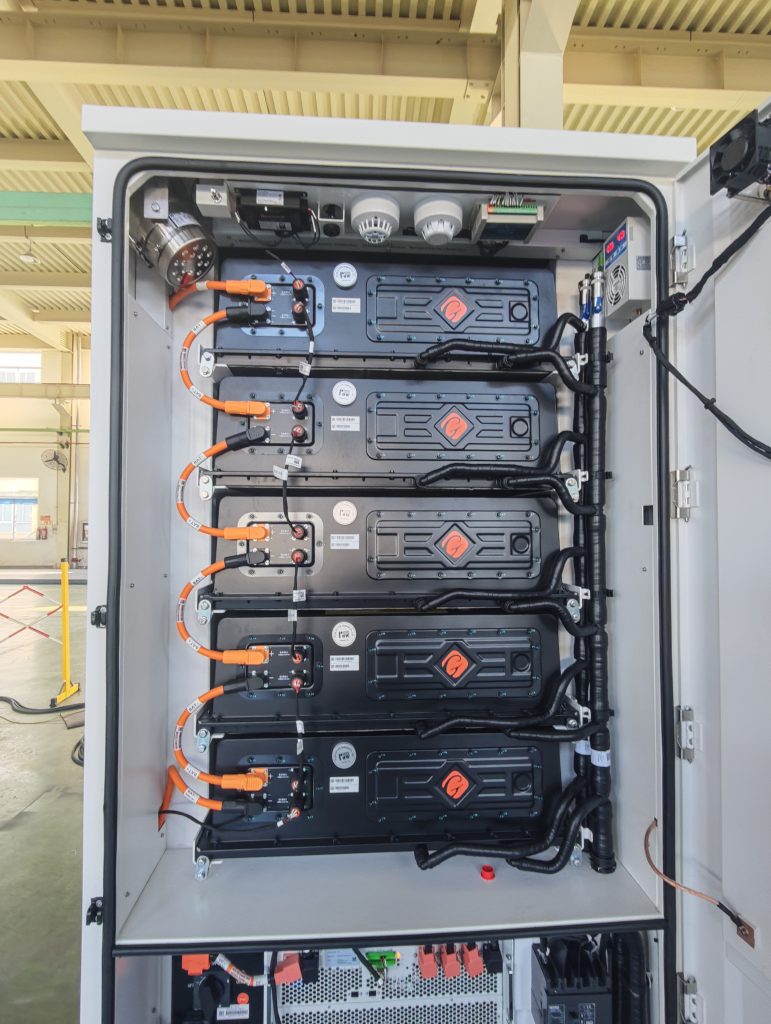
The quality of a BESS enclosure is defined by its weakest point. Here are the engineering details that maintain the IP boundary.
Pressure Equalization Vents: Temperature swings create pressure differentials. Installing hydrophobic membrane vents (often ePTFE) allows air molecules to pass for pressure equalization while blocking water droplets.
Cable Glands and Roxtec Seals: Penetrations for power and data cables are notoriously vulnerable. Simple rubber grommets degrade and crack. Multi-cable transit systems (like those from Roxtec) or IP68-rated compression glands are essential. They provide strain relief and a holistic seal that adapts to cable diameter variances.
Drainage and Sloped Roofs: Design should never rely solely on seals. A sloped roof (minimum 3-5 degrees) prevents water pooling. Internal drip loops on cables ensure water flows away from connectors. Passive drainage plugs at the bottom of the cabinet allow any condensation that does form to escape without letting water in.
Conclusion
Choose IP ratings with purpose—IP66 often hits the sweet spot for walk‑in containers, while IP67/IP68 fit select subcomponents like connectors and glands. Go beyond IP: validate IK impact resistance, check NEMA 4X for corrosion protection etc. Finally, protect the rating in practice with pressure equalization vents, quality cable seals, sloped roofs, and scheduled gasket/coating maintenance. This way your battery enclosure stays dry, reliable, and serviceable—lowering lifecycle cost while keeping uptime high.
Need help navigating through BESS hardware options? Contact our team on info@eco-greenenergy.com or read more about EGE’s BESS Solutions.
If you like this type of content, follow our LinkedIn Newsletter for more insights, industry news and updates.