
Peak shaving is an energy management strategy that reduces a facility’s maximum electricity demand during high-cost periods. A Battery Energy Storage System, controlled by an Energy Management System, discharges stored energy when demand approaches a peak threshold, helping businesses lower demand charges, improve solar PV self-consumption, and reduce reliance on expensive grid electricity.
Introduction
For many commercial and industrial facilities, the highest electricity costs do not come only from total energy consumption. They often come from peak demand charges.
A short spike in electricity usage can significantly increase a company’s energy bill, especially when the grid applies demand-based tariffs. This is where Battery Energy Storage Systems and advanced Energy Management Systems create measurable value.
By using stored energy at the right moment, businesses can reduce demand peaks, improve energy efficiency, and optimize the return on investment of solar PV and battery storage projects.
What is peak shaving?
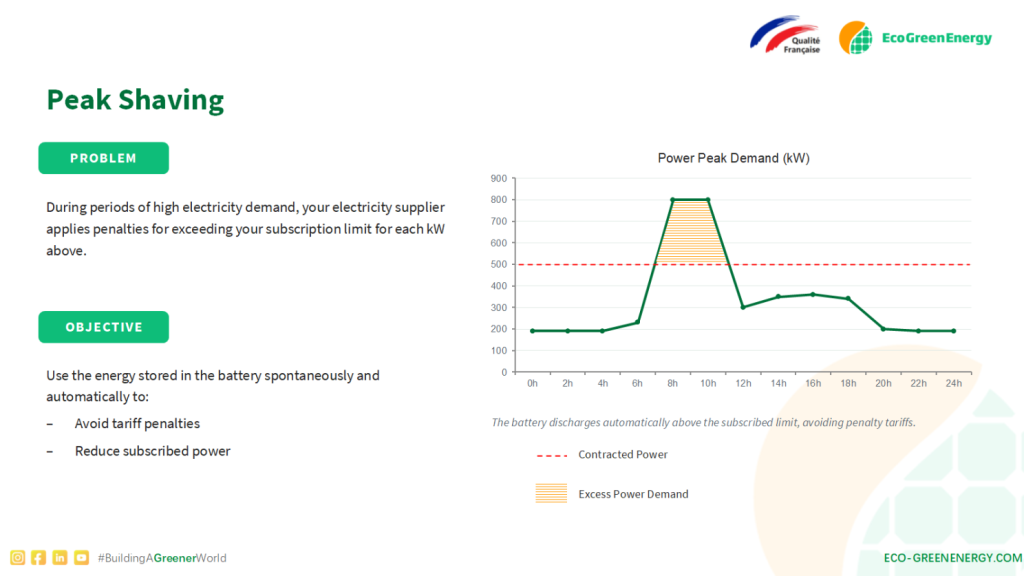
Peak shaving is the process of reducing the highest level of electricity demand recorded by a facility during a billing period.
Instead of drawing all required power from the grid during demand spikes, a facility can use stored energy from a battery system. This lowers the visible demand placed on the grid and can reduce demand-related electricity costs.
In simple terms: peak shaving means using stored energy to avoid expensive electricity demand peaks.
Why peak demand charges matter for businesses
Many energy-intensive businesses pay for electricity in two main ways:
- Energy consumption charges These are based on the total amount of electricity used, usually measured in kWh.
- Demand charges These are based on the highest power demand reached during a specific period, usually measured in kW.
Even if a demand spike lasts only a short time, it can affect the electricity bill for the entire billing cycle. For factories, warehouses, commercial buildings, EV charging sites, and industrial facilities, this can represent a major operational cost.
For manufacturers in particular, combining solar PV with BESS can help reduce energy cost volatility and improve long-term operational stability.
How BESS enables peak shaving
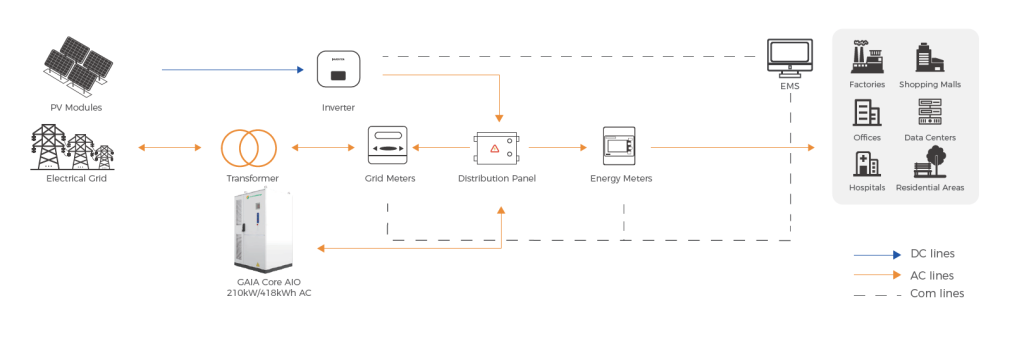
A Battery Energy Storage System stores electricity and releases it when needed. When connected to an intelligent Energy Management System, the battery can respond automatically to demand peaks.
Here is how the process works:
- The Energy Management System monitors real-time electricity consumption.
- The system identifies when demand is approaching a costly threshold.
- The BESS discharges stored energy to support the facility.
- Grid demand is reduced during the peak period.
- The facility avoids or limits high demand charges.
This automated response allows operations to continue normally without relying entirely on high-cost grid electricity.
The role of Energy Management Systems in smart energy management
A BESS is not only a large battery. Its real value depends on how intelligently it is controlled. An Energy Management System analyzes consumption data, battery status, solar PV production, electricity tariffs, and operational needs. It then decides when to charge, store, or discharge energy.
A modern Energy Management System can support:
- Automated peak shaving
- Solar PV self-consumption optimization
- Time-of-use tariff optimization
- Grid arbitrage
- Backup power strategies
- Real-time energy monitoring
- Battery performance management
This transforms energy storage from a passive asset into an active cost-optimization platform. It also explains why two battery systems with the same capacity can deliver different results depending on system design, battery configuration, and control strategy. Eco Green Energy explains this point in more detail in this article: Why Two Battery Energy Storage Systems With the Same Capacity Can Perform Completely Differently.
BESS and solar PV: improving renewable energy ROI
Solar PV production often peaks during the middle of the day. However, many facilities experience their highest electricity demand in the morning, late afternoon, or evening.
Without storage, excess solar energy may be exported to the grid or underused. With a BESS, that energy can be stored and used later when electricity is more expensive or when demand increases.
This helps businesses:
- Increase solar self-consumption
- Reduce grid dependency
- Improve solar PV return on investment
- Lower exposure to peak tariffs
- Support decarbonization goals
For companies investing in renewable energy, combining solar PV + BESS + Energy Management System creates a more flexible and financially efficient energy system. This is especially relevant for industrial facilities and manufacturers looking to reduce operating costs with solar and storage solutions.
Peak shaving without solar: is it still useful?
Yes. Peak shaving can also benefit facilities without solar PV.
A BESS can charge during off-peak hours, when electricity prices are lower, and discharge during peak hours, when grid electricity is more expensive. This is often called energy arbitrage or time-of-use optimization.
For businesses with variable load profiles, this can reduce electricity costs and improve energy predictability.
A BESS can also support backup power strategies. In some applications, battery storage can reduce dependency on diesel generators or complement them for a cleaner and more flexible energy setup. Learn more here: Can Battery Storage Replace Diesel Generators?
Key benefits of BESS for peak shaving
1. Lower electricity demand charges
By reducing the highest grid demand peaks, businesses can lower one of the most expensive parts of their electricity bill.
2. Better control over energy costs
A BESS helps facilities become less exposed to sudden demand spikes and tariff fluctuations.
3. Improved solar PV performance
Stored solar energy can be used when it creates the highest financial value.
4. Increased operational resilience
Energy storage can support critical loads and improve energy flexibility
5. Smarter sustainability strategy
Peak shaving helps companies reduce grid stress and make better use of renewable energy.
Which businesses can benefit from peak shaving?
Peak shaving is especially relevant for organizations with high or variable power demand, including:
- Manufacturing plants
- Warehouses and logistics centers
- Commercial buildings
- Shopping centers
- Cold storage facilities
- EV charging stations
- Hotels and resorts
- Industrial sites
- Agricultural operations
- Sites with solar PV installations
Any facility facing high demand charges or unstable load peaks can evaluate BESS as part of its energy strategy.
How to know if your facility needs peak shaving
A facility may benefit from peak shaving if:
- Electricity bills include high demand charges
- Power demand varies significantly during the day
- Equipment starts create short but expensive demand spikes
- Solar PV production does not match consumption patterns
- The site wants to reduce grid dependency
- Energy costs are difficult to predict
- The business is planning EV charging or additional electrical loads
The best starting point is an energy consumption analysis. Load profile data can show when peaks occur, how often they happen, and how much a BESS could reduce them.
FAQ
Peak shaving is a strategy used to reduce a facility’s highest electricity demand during peak periods. It helps lower demand charges by using stored energy instead of drawing all power from the grid.
A BESS reduces peak demand by discharging stored electricity when a facility’s consumption approaches a high-demand threshold. This lowers the amount of power drawn from the grid.
Peak shaving reduces short-term demand peaks. Load shifting moves electricity consumption from high-cost periods to lower-cost periods. A BESS can support both strategies.
Yes. Solar PV and BESS work well together. Excess solar energy can be stored during production peaks and used later when demand or electricity prices are higher. This is one of the main reasons manufacturers and commercial facilities combine solar PV with battery storage.
An EMS is highly recommended because it automates decision-making. It monitors consumption, tariffs, solar production, and battery status to optimize when the BESS charges and discharges.
No. A BESS can provide backup power, but it can also reduce electricity costs, optimize solar energy, support grid flexibility, and improve energy management. In some cases, it can also reduce the need for diesel generator usage. Read more: Can BESS Replace Diesel Generators?
Conclusion
Peak shaving is no longer only a technical energy strategy. It is a practical way for businesses to reduce operating costs, improve energy flexibility, and make renewable energy investments more profitable.
With the right combination of BESS, Energy Management System, and solar PV, companies can move from simply consuming electricity to actively managing it.
The energy transition is not only about producing more clean energy. It is about using energy smarter.
Want to understand how much your facility could save with peak shaving? Contact Eco Green Energy to evaluate your energy profile and identify the right BESS strategy.
You can also follow Eco Green Energy’s updates and industry insights through the Eco Green Energy LinkedIn Newsletter.


