Common Ways Solar Panels Lose Power (And How to Prevent Them)
Solar panels are a remarkable technology. You place them under the sun, and they convert sunlight into usable electricity. Simple, right? In theory, yes — but in reality, many photovoltaic (PV) modules underperform. That means you’re not getting all the energy you paid for.
So, where does the missing solar energy go? And more importantly, how can you get it back?
In this article, we’ll break down the most common causes of energy loss in solar panels and what manufacturers and project developers can do to reduce them.
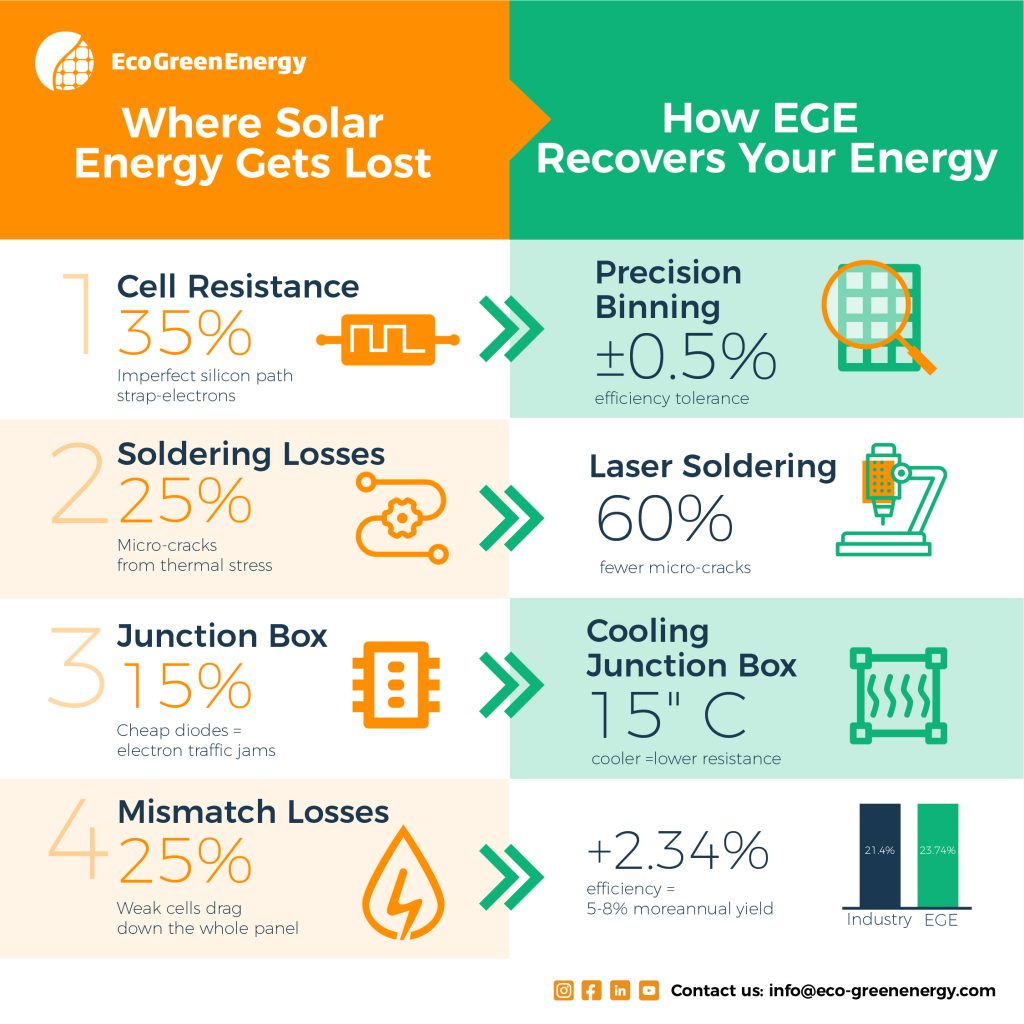
1. Cell Resistance: Trapped Electrons = Lost Energy (35%)
Inside every solar panel are solar cells made from silicon. These cells create an electric field that moves electrons when sunlight hits them. But here’s the catch: not all silicon is created equal.
Some manufacturing processes leave micro-defects or impurities in the silicon crystal structure. These flaws block or trap electrons, preventing them from flowing freely. That resistance reduces the panel’s efficiency. In fact, internal cell resistance can account for up to 35% of total energy loss in a poorly made panel.
What helps?
- Using high-purity silicon
- Proper doping to balance conductivity
- Careful manufacturing to avoid lattice defects
2. Soldering Losses: The Micro-Crack Problem (25%)
Solar cells are connected by thin metal ribbons. These are soldered using heat. If done too quickly or at inconsistent temperatures, the heat creates micro-cracks.
Micro-cracks are tiny fractures that break the path for electricity to flow. At first, you might not notice them. But over time, as thermal stress and expansion take a toll, these cracks expand and lead to hotspots and performance drops.
Solutions include:
- IR soldering: A controlled, low-stress process that dramatically reduces thermal impact. Infrared heating can be used to heat solar cells, allowing solder to connect copper wire to the silver electrode.
- Automated QC inspections: To detect and eliminate cracked cells before assembly
With better soldering, energy losses can drop by 60% in this category alone.
3. Junction Box Losses: Small Component, Big Impact (15%)
The junction box sits on the back of every panel. It may seem like a small component, but it plays a big role. Inside are diodes that prevent backflow and help the current exit the panel efficiently.
Cheap or poorly designed junction boxes often overheat or create resistance due to low-quality diodes. That heat leads to further energy loss and long-term degradation.
How to improve it?
- Use high-quality bypass diodes
- Add passive or active cooling features
- Regularly test for overheating in R&D and QC stages
Some upgraded junction boxes operate up to 15°C cooler — which reduces resistance and prolongs system life.
4. Mismatch Losses: One Weak Cell Hurts Them All (25%)
A solar panel is only as strong as its weakest link. If even one cell underperforms, it drags down the performance of the entire module. This is called mismatch loss.
Causes include:
- Variations in cell efficiency
- Uneven light exposure
- Inconsistent binning during production
The result? About 25% of potential energy can be lost because one or two cells aren’t pulling their weight.
Best practice?
- Precision binning: Grouping cells by performance during production
- Better quality sorting: Ensures uniform output within each panel
- Cell matching software: Detects mismatches early
So… How Do We Get That Energy Back?
The first step is always to prevent it, of course! First of all, you have every right to request EL test results and BOM reports from your suppliers, to see if there are any issues to begin with.
Reducing energy losses in solar panels is not about reinventing the wheel — it’s about doing the basics right, with precision and care.
Here’s how a few key design and quality steps can recover that missing energy:
+0.5% Binning Tolerance: Means cells in each panel are closely matched for output
Laser Soldering: Up to 60% fewer micro-cracks = longer lifespan
Cooler Junction Boxes: Lower resistance, better diode performance
Strict QC and Material Selection: Prevents underperformance from the start
Put together, these improvements can result in a +2.34% increase in efficiency — which translates to 5–8% more energy yield annually compared to the industry average.
Why It Matters for You
Whether you’re a project developer, EPC, or business owner installing a solar system — understanding where energy is lost helps you make smarter decisions.
- You can ask the right questions.
- You can compare products more effectively.
- You’ll know that price isn’t everything — quality pays off over time.
The EGE Commitment
At Eco Green Energy, we take these issues seriously. That’s why:
- We use only Grade A raw materials
- Every panel goes through advanced electroluminescence testing
- Our in-house QC system verifies performance before anything ships
Because energy shouldn’t be wasted — especially when it comes from the sun.
Ready to learn more about PV performance and smart design? Check out our full Academy archive and stay updated with the latest in solar technology and energy storage.