
Unlock sophisticated energy control for your clients. Learn how to leverage AC-coupled batteries to integrate PV systems with modern domotics for peak shaving, EV charging, and complete energy orchestration.
The New Frontier of Solar Autonomy
France has seen a rapid rise in rooftop solar installations, but many systems operate without battery storage. These homes produce renewable electricity during the day but must rely on the grid in the evening. This leads to missed savings, limited resilience, and reduced autonomy.
Fortunately, upgrading these systems no longer requires a full redesign. Homeowners can modernize their installations quickly, affordably, and with full compatibility. This also marks an incredible opportunity for distributors, EPCs and renewable energy professionals.
Why Retrofit — Not Replace
Many believe that adding storage requires replacing the inverter, but that’s no longer the case. AC-coupled batteries connect to the home’s electrical panel, not the PV strings. The existing inverter remains untouched, and the upgrade becomes fast and minimally invasive. Systems like Novatra Reflex can often be installed in under two hours.
Why this works:
- Keep the existing inverter — no major equipment replacement
- Fast installation — typically completed within a single visit
- Lower project costs — reduced materials and labour
- Immediate gains in self-consumption — store excess solar for evening use
Retrofit transforms a PV-only system into a modern, high-performance energy installation without dismantling anything.
AC-Coupled vs. DC-Coupled: The Right Tool for the Job
| Coupling Type | Best Use Case | Key Advantage |
|---|---|---|
| AC-Coupled | Retrofitting existing solar PV systems | Easy to install without modifying the PV array or original inverter. Universal compatibility. |
| DC-Coupled | New solar + storage installations | Higher round-trip efficiency as power is converted only once. Often a more compact, all-in-one design. |
How AC-Coupled Batteries Work — and Why They Unlock Peak Shaving
AC-coupled systems follow a simple flow:
- Solar generation powers household loads first.
- Excess energy charges the battery via the inverter.
- At night or during peak-tariff periods, the battery discharges into the home.
This structure supports:
- Time-of-use optimization
- Load shifting for EV charging
- Backup power for essential circuits
- Smart automation through EMS and domotics
While AC systems involve double conversion, modern batteries achieve 85–95% round-trip efficiency, making the trade-off negligible compared to the compatibility and simplicity gains.
The Energy Control Stack: From PV to Full Home Orchestration
The modern solar home is a coordinated ecosystem. A complete retrofit smart-energy architecture includes:
1. The existing PV system
Already installed and functioning.
2. AC-coupled battery (like Novatra Reflex)
Adds storage without replacing the inverter.
3. BMS (Battery Management System)
Ensures safety, state-of-charge accuracy, and cell balancing.
4. EMS / HEMS (Energy Management System)
Controls the flow of power between PV, battery, home loads, and grid.
5. Smart Meter Integration
Reads live consumption and tariff data.
6. Domotics ecosystem (Voltisia) – Optional
The intelligence layer that turns the home into a smart, responsive energy environment.
Key Safety & Compliance Considerations (France + EU)
Adding a battery to a home is a technical process, and installers must follow national and European rules.
Electrical Compliance: Look for CE marking and compliance with:
- Low Voltage Directive (2014/35/EU)
- EMC Directive (2014/30/EU)
Certification Standards: Choose systems certified under:
- IEC 62619 (cell & battery safety)
- IEC 62040 (operating safety for UPS systems)
Installation Standards: In France: NF C 15-100. Always follow the grid operator’s interconnection rules.
Installer Qualifications: France: RGE certification is recommended.
Battery Placement & Fire Safety: Ensure required clearances, ventilation, and fire-safety measures.
Cybersecurity: Smart batteries communicate with the cloud.
Retrofit Readiness Checklist
- Inverter details: make/model, firmware version, single-/three-phase, anti-islanding profile
- Site load profile: interval data (12 months if available), tariff structure and TOU windows
- Interconnection and compliance: paperwork, NF C 15-100 items – pending on each country
- ESS certifications & installer quals: CE, IEC 62619/62040, etc.
- Physical constraints: clearances, ventilation, cable routes, fire safety requirements
- Commissioning/tests: backup circuits mapping, RTE/efficiency checks, initial SoH baseline
- Domotics integration: KNX/Zigbee/Z-Wave support, smart meter/API integration
- Logistics: stock/lead times, SKU mapping, accessories, documentation pack
The Economics: ROI, Self-Consumption Gains, and Grid Savings
A retrofit increases self-consumption from 20–30% to 60–70%+, reducing grid reliance and lowering electricity bills. Time-of-use optimization and EV charging amplify savings. Retrofit storage also enhances resilience without requiring a generator.
Example: A typical French home with a 3-9 kWp rooftop solar system might only self-consume 20-30% of its generated power. By adding a correctly sized battery, this can often be increased to 60-70% or more.
Why EGE’s “Novatra Reflex” Is THE Solution
Novatra Reflex was designed specifically for retrofit customers who already invested in solar. Its AC-coupled design makes it compatible with 100% of existing installations, and installation is as simple as connecting it to the home electrical panel.
Key features include:
- 5–12 kWh capacity, expandable to 4 units
- Plug-in AC retrofit with no equipment replacement
- IP65 protection for indoor or outdoor use
- Premium LiFePO4 cells from Pylontech
- AI-optimized performance
- Local backup mode for resilience
- Fast installation — often under two hours
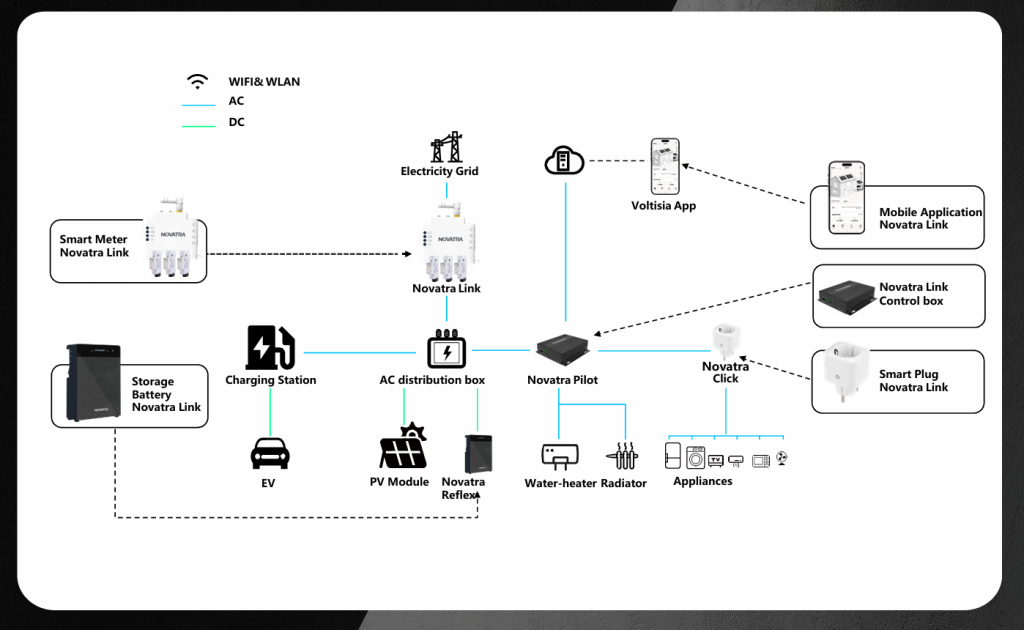
Domotics & Smart Energy Control — The Voltisia Advantage
Where Novatra truly stands out is due to the ecosystem behind it. Voltisia, the smart-control platform, adds a full domotics layer across a home’s electrical consumption.
Through the Voltisia App, you can:
- Monitor household consumption in real time
- Analyse tariffs, solar production, and load habits
- Trigger automations or let AI manage optimization
- Control devices through smart plugs (Novatra Click)
- Adjust heating power with Novatra Pilot
- Track each appliance’s energy consumption
- Extend battery life through optimized charge cycles
- Receive alerts, maintenance notifications, and anomaly detection
Voltisia turns the home into a smart energy ecosystem, adjusting in real time to tariffs, weather, and lifestyle. And because it’s app-based, it works across Europe regardless of national grid or tariff systems.
Applying This Across EU Countries
The benefits of retrofitting with an AC-coupled battery are not limited to France. Across the EU, homeowners with existing solar installations face the same challenge. The principles of AC-coupling are universally applicable. While specific incentives, subsidies, and grid codes vary by country, the fundamental value proposition remains the same.
Novatra Reflex’s installer-friendly design reduces labor complexity, its CE-compliance ensures it meets rigorous EU safety standards. Meanwhile its modularity allows it to be adapted to a wide range of home sizes and energy needs. With a robust mobile app and dedicated support for the French and EU markets, Novatra provides a reliable, future-proof investment for any solar homeowner looking to upgrade.
Ready to equip your customers with storage?
Contact Eco Green Energy today to request pricing. You can also pass by our booth at Salon EnerGaïa Hall B3 Stand B52 for more information and a live-demo!
Contact us at info@eco-greenenergy.com or if you enjoy our content subscribe to our LinkedIn Newsletter for more insights, industry news, and updates from Eco Green Energy.
Discover our other BESS solutions for C&I and Utility scale projects here.


