
As solar markets in the world experience incredible growth, procurement teams need strategic frameworks for building successful partnerships. Whether working directly with manufacturers or through authorized distributors or traders, the key to success lies in transparency, proper due diligence, and creating value-aligned relationships that benefit all parties.
The Solar Distributor Crisis
The Hidden Crisis: Solar developers increasingly encounter procurement problems. It’s not uncommon to receive such feedback from new clients that diverted directly to us after being trapped in toxic partner relationships with their suppliers.
How it’s done?
Certain traders trap clients with attractive initial pricing. Subsequently, these companies implement mid-contract price increases, citing “raw material cost escalations.” Distributor margins reach 10% or more, while end consumers pay higher costs. Meanwhile, certain traders maintain complete control over both pricing and supply timing.
In our analysis, we will provide actionable frameworks for procurement teams to avoid such issues. Furthermore, we will demonstrate how successful manufacturer-distributor-customer relationships create value for all parties. Finally, we explore best practices that leading companies use to optimize their solar supply chains.
| Partnership Excellence | The Strategic Solution |
| Quality distributors provide valuable local expertise, market knowledge, and support services. Meanwhile, direct manufacturer relationships offer supply chain transparency and technical access. | Successful procurement requires comprehensive partner evaluation criteria. This includes financial stability, technical capabilities, regional expertise, and commitment to transparency. |
Partnership Models: Maximizing Value Across the Supply Chain
Understanding Solar Procurement Partnership Options
Modern solar procurement offers multiple partnership models. Each approach provides distinct advantages when properly structured. The key lies in matching partnership models to project requirements and organizational capabilities.
| Direct Manufacturer Partnership | Quality Distributor Partnership | Hybrid Partnership Model |
| Best for: Large-scale projects, customization requirements, technical development – Supply chain transparency – R&D collaboration access – Product customization capabilities – Long-term strategic planning | Best for: Regional expertise, local support, market navigation – Local market knowledge – Regional regulatory expertise – Installation support networks – Inventory management | Best for: Diversified procurement, risk mitigation, market flexibility – Portfolio diversification – Risk distribution – Market responsiveness – Competitive benchmarking |
Warning Signs: Identifying Problematic Partners
Red Flags in ANY Partnership
- Lack of price transparency or detailed cost breakdowns
- Vague contract terms regarding price escalations
- Inability to provide financial stability documentation
- Limited technical support or engineering capabilities
- Weak reference customer testimonials
- Resistance to performance guarantees
- Poor communication or delayed responses
- Unrealistic promises or pricing compared to market
Industry Challenge: Mid-Contract Price Escalations
Some suppliers exploit contract loopholes through mid-contract price increases. Material price escalation clauses have become a significant concern, with increases ranging from 10-25% cited as “raw material cost adjustments.”
10-25%: Typical mid-contract price escalations
Contract manipulation tactics
Increased project costs
Solution: Comprehensive Partner Evaluation Framework
| Evaluation Criteria | Quality Indicators | Documentation Required | Risk Level |
| Financial Stability | Audited financials, credit ratings, banking references | 3-year financial statements, insurance certificates | Low |
| Price Transparency | Detailed cost breakdowns, fixed-price commitments | Itemized pricing, escalation limits documentation | Low |
| Technical Capabilities | Engineering team access, technical support structure | Technical team profiles, support service agreements | Medium |
| Regional Expertise | Local market knowledge, regulatory compliance experience | Regional project portfolio, compliance certifications | Medium |
Strategic Partnership Benefits: Creating Value for All Stakeholders
Successful solar procurement partnerships create mutual value through transparency, expertise sharing, and risk mitigation. Moreover, these relationships enable innovation, market development, and sustainable business growth across the supply chain.
Success Story: Integrated Partnership Model
At Eco Green Energy we are manufacturers with R&D facilities in France and our own manufacturing operations in China. We demonstrate the integrated partnership approach. We work both directly with large end customers and through quality authorized distributors who add regional value and we select ourselves.
This model combines European engineering expertise with Chinese manufacturing scale while leveraging local market knowledge. The result benefits all parties involved, from the client, the distributor and the end-user, through optimal resource allocation and market coverage.
Solar equipment prices always fluctuate, raw material prices go up and down every few months and with every geopolitical challenge. This does not justify mid-contract price alterations or supply chain disruptions. We always advice both our clients and our readers, to ensure such clauses in their contracts.
Let the Data Talk: Supply Chain Resilience and Partnership Performance
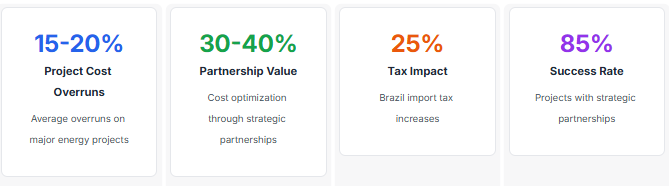
Industry analysis reveals that successful solar projects depend on resilient supply chain partnerships. Major energy projects face 15-20% cost overruns, with procurement strategy directly impacting project success. Strategic partnerships help mitigate these risks effectively.
Key Success Factors for Solar Energy Project Partnerships
Research identifies critical factors that distinguish successful partnerships from problematic relationships. These factors apply regardless of partnership model—direct, distributor, or hybrid approaches.
- Transparent Communication: Regular updates on production, delivery, and potential challenges enable proactive problem-solving
- Financial Stability: Partners with strong financial foundations provide greater project security and warranty support
- Technical Competence: Access to qualified engineering teams ensures proper system design and troubleshooting capabilities
- Regional Knowledge: Understanding of local regulations, grid codes, and market conditions reduces project risks
- Performance Accountability: Clear metrics, guarantees, and remediation processes protect project economics
“Successful solar procurement requires strategic thinking about partnerships rather than simply seeking the lowest price. Quality relationships create value through reliability, innovation, and market expertise.”
Strategic Partnership Development Framework
| Assessment Phase | Selection Phase | Partnership Phase |
| – Market analysis & requirements definition – Partner identification and preliminary screening – Capability assessment and due diligence – Risk evaluation and mitigation planning | – Competitive evaluation & scoring – Technical capability verification – Financial stability confirmation – Reference customer validation | – Contract negotiation & execution – Performance monitoring and optimization – Relationship management and development – Continuous improvement initiatives |

Conclusion: Building Excellence Through Strategic Solar Partnerships
The future of solar procurement in areas like the Balkans and South America depends on building strategic partnerships that create value for all stakeholders. Whether working through quality distributors or directly with manufacturers, success requires transparency, proper evaluation, and mutually beneficial relationships.
Key Success Principles
- Quality distributors provide valuable regional expertise and local market knowledge
- Direct manufacturer relationships offer supply chain transparency and technical collaboration
- Comprehensive partner evaluation prevents problematic relationships regardless of channel
- Transparent communication and fair contracts benefit all parties in the supply chain
- Strategic partnerships create competitive advantages through innovation and efficiency
Conclusion: Partner with Quality Suppliers
Leading manufacturers like Eco Green Energy, work with only authorized distributors and are also able to work directly on C&I or Utility projects based on transparency, mutual support and putting customer first.
Together, we can build a stronger, more resilient supply chain that benefits everyone alike.
Ready to upgrade your solar partnerships?
You can find our key distributors listed on our website. If you have a project that you want to work on directly with us, or if you want to partner with us, feel free to email us at: info@eco-greenenergy.com. You can also subscribe to our LinkedIn Newsletter for more insights, industry news, and updates from Eco Green Energy.


