
Air vs Liquid vs Immersion — benefits, applications, and how to choose.
Thermal management is the basis of any Battery Energy Storage System (BESS). Without appropriate cooling, lithium-ion cells may present accelerated degradation, thus reducing the system’s lifespan and return on investment. Most importantly, uncontrolled heat generates safety risks, potentially leading to thermal runaway and critical failure. A good cooling system maintains cell temperatures within the “Goldilocks zone” of 15°C to 35°C, ensuring consistent performance and safety. Ultimately, the right cooling strategy protects your assets and maximizes energy throughput.
Cooling Methods Explained
1. Air Cooling Systems
Definition: Air cooling uses HVAC units or fans to move conditioned air through battery racks, removing heat by convection.
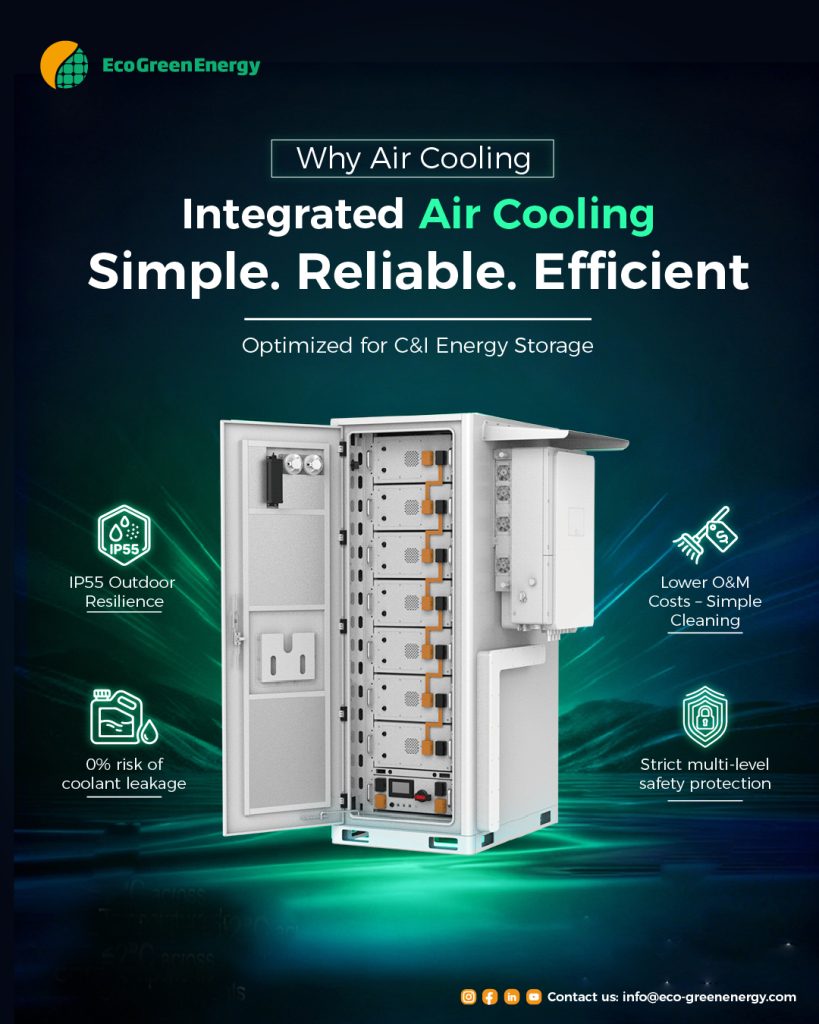
Air cooling is still the standard for many stationary storage applications. This method uses HVAC units or industrial fans to circulate conditioned air through the battery racks, removing heat via convection. It is simple, reliable, and uses proven technology.
Top Benefits: Low upfront cost and straightforward maintenance (mostly filter changes).
Best Applications: Ideal for C&I (Commercial & Industrial) systems with lower discharge rates (below 0.5C) where extreme density is not required.
Our EGE Gaia Flex AIO cabinet 50kW/112kWh is an excellent solution for such C&I projects and features advanced air cooling system.
2. Liquid Cold Plate Cooling
Definition: Liquid cold plate systems circulate a water‑glycol mix through plates in contact with battery modules for targeted heat removal.
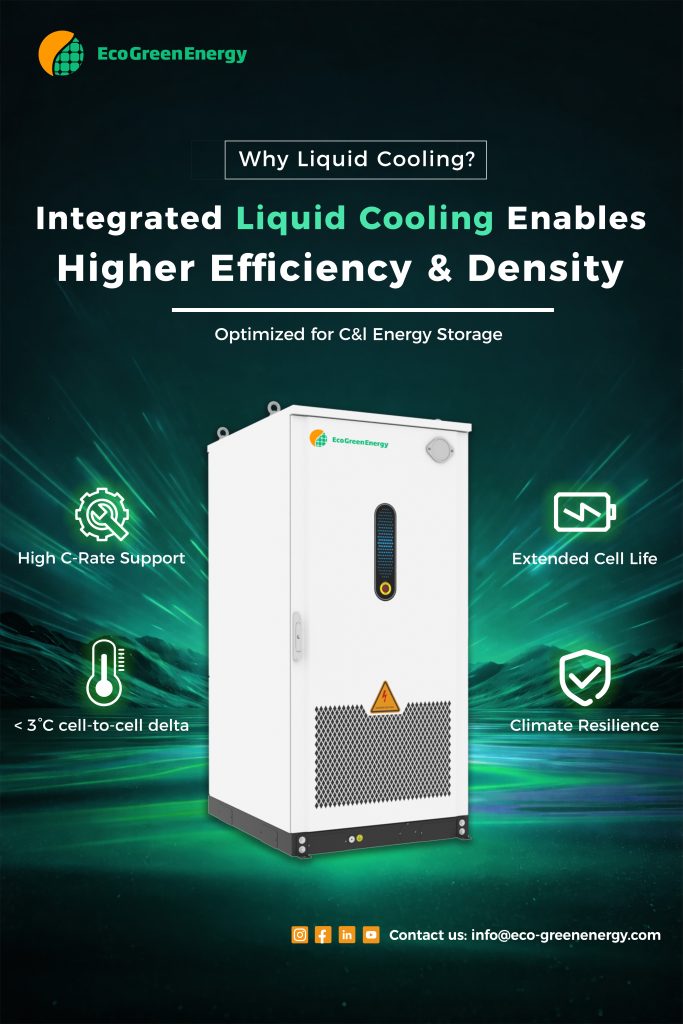
Liquid cooling circulates a water-glycol mixture through metal plates located between battery modules. Since water conducts heat roughly 20 times better than air, this method offers precise temperature control. It targets heat at the source, rather than cooling the entire room.
Top Benefits: High thermal efficiency and compact system footprint.
Best Applications: Essential for large-scale utility projects and high-performance systems requiring rapid charging/discharging (above 1C).
EGE’s GAIA Core 261kWh AIO cabinet is a perfect large-scale utility solution, featuring liquid cold plate cooling.
3. Immersion Cooling
Definition: Immersion cooling submerges cells in non‑conductive dielectric fluid, eliminating hot spots and instantly quenching thermal events.
Immersion cooling submerges battery cells directly into a non-conductive dielectric fluid. This technique provides the ultimate thermal contact, eliminating hot spots entirely. It suppresses thermal propagation immediately, offering unparalleled safety.
Top Benefits: Perfect temperature uniformity and superior fire suppression capabilities.
Best Applications: Suited for ultra-high-density data centers or specialized environments where safety and performance outweigh higher costs.
Side-by-Side Comparison of Different BESS Cooling Systems
| Criteria | Air Cooling | Liquid Cold Plate | Immersion Cooling |
|---|---|---|---|
| Thermal Performance | Moderate | High | Extreme |
| Temperature Uniformity | Low (gradients exist) | High | Perfect |
| Footprint Density | Low (needs air gaps) | High | Very High |
| Maintenance Complexity | Low (filters/fans) | Medium (pumps/fluids) | High (fluid handling) |
| Leak Risk | None | Moderate (connections) | Low (contained tank) |
| Noise Level | High (fans) | Low | Silent |
| Upfront Cost | $ (Lowest) | $$ (Moderate) | $$$ (Highest) |
| Best Applications | General C&I, Microgrids | Utility Scale, EVs | High-Performance, IT |
Choosing the Right BESS Cooling System
Start with duty cycle. If your system operates below ~0.5C for long durations, air cooling often delivers the best return thanks to simpler service. When you push above 1C or need rapid transients, liquid cold plates keep temperatures uniform and prevent derating. In ultra‑dense or high‑risk environments, immersion offers the highest safety margin.
Next, consider climate and footprint. Hot sites (>40°C) and tight urban spaces typically favor liquid or immersion. Finally, weigh CAPEX and OPEX. Air has the lowest upfront cost, but liquid systems may save auxiliary energy and reduce derating penalties over time.
Quick FAQs
What is air cooling in BESS?
Air cooling (HVAC) uses fans and AC units to move cool air through the cabinet, removing heat via convection. It suits lower‑intensity applications and moderate climates. Standards like IEC 62933‑5‑2 allow air cooling when temperature limits and propagation controls are met.
When should I choose liquid cold plate?
Select liquid cooling for high performance with C‑rates above 1C, or where space is tight and temperatures need tight control. Circulating a water‑glycol mix against cells delivers superior uniformity and density compared to air systems.
Does compliance affect BESS cooling system decisions?
Yes. System‑level safety frameworks (e.g., IEC 62933‑5‑2, NFPA 855) require demonstrating that thermal events are contained. Your cooling method and fire suppression plan should work together.
Conclusion & Next Steps
Effective cooling is the backbone of a reliable energy storage system. While liquid and immersion technologies grab headlines for performance, advanced air-cooling remains the robust, economical choice for many commercial applications. The EGE GAIA Flex AIO exemplifies this balance, integrating a smart air-conditioning system with a 50kW/112kWh LiFePO4 battery to ensure safety and longevity in a compact outdoor cabinet.
Ready to upgrade your energy strategy? Explore the GAIA Flex AIO capabilities or contact our sales team today to configure the perfect solution for your site.
Need help selecting a cooling architecture? Contact our engineering team on info@eco-greenenergy.com or read more about EGE’s BESS Solutions.
If you like this type of content, follow our LinkedIn Newsletter for more insights, industry news and updates.


