
Eco Green Energy targets 100 MW for rheir Neptune floating PV system in Latin America region.
As global demand for clean energy accelerates, developers and industries are seeking solar solutions that maximize available space without compromising operational or environmental priorities. Floating photovoltaic (FPV) systems have emerged as one such answer, offering a unique opportunity to deploy solar on water bodies that would otherwise remain unused.
Yet despite the growing buzz around FPV, many professionals still ask: where does it really work, what does it cost, and is it reliable at scale? At Eco Green Energy, we’ve been addressing these questions firsthand. Through our Neptune FPV system and active deployments across LATAM, we’re not only bringing this technology to life but also working to demystify it.
In this article, we explore key considerations around FPV, reflect on insights from our recent interview with regional media outlet Energía Estratégica, and share practical advice for those considering adopting the technology.
Where and When Does Floating PV Make Sense?
Floating PV in Practice!
Floating PV involves installing solar modules on water surfaces, typically using a system of buoyant, corrosion-resistant floats and anchoring mechanisms. The best candidates for FPV are controlled water bodies with minimal surface agitation and consistent water levels. These include:
- Agricultural reservoirs and irrigation ponds
- Aquaculture farms and fish hatcheries
- Industrial retention basins or water treatment lagoons
- Drinking water or hydroelectric reservoirs (with appropriate permits)
FPV is particularly compelling in areas where land is scarce, expensive, or reserved for food production. It also creates added value by reducing water evaporation and shading the surface, which can limit algae growth.
One example is our Neptune installation for a shrimp farm in Ecuador. The site had minimal space for land-based systems but abundant access to water. With FPV, the farm not only offset fossil fuel use but also improved water temperature regulation and evaporation control, enhancing overall operations.
Where FPV Should Be Avoided
Despite its versatility, FPV is not suitable for every environment. The following scenarios present risks or practical limitations:
- Fast-moving or tidal waters: Rivers, tidal bays, or water bodies with high flow rates can destabilize the system.
- Extreme wave conditions: Sites subject to heavy winds or large wave action require expensive reinforcements, potentially undermining cost-efficiency.
- Remote or inaccessible sites: Locations without stable access roads or transport infrastructure can complicate installation and maintenance.
- Protected ecosystems: Environmental restrictions may prohibit FPV development in certain biodiversity-rich or conservation-designated areas.
- Shallow or highly variable water levels: Inconsistent depth may complicate anchoring or even expose floats during dry seasons.
A full feasibility study is crucial before committing to FPV. At Eco Green Energy, we work closely with clients to evaluate these technical and environmental factors before design begins.
How Long Does Installation Take?
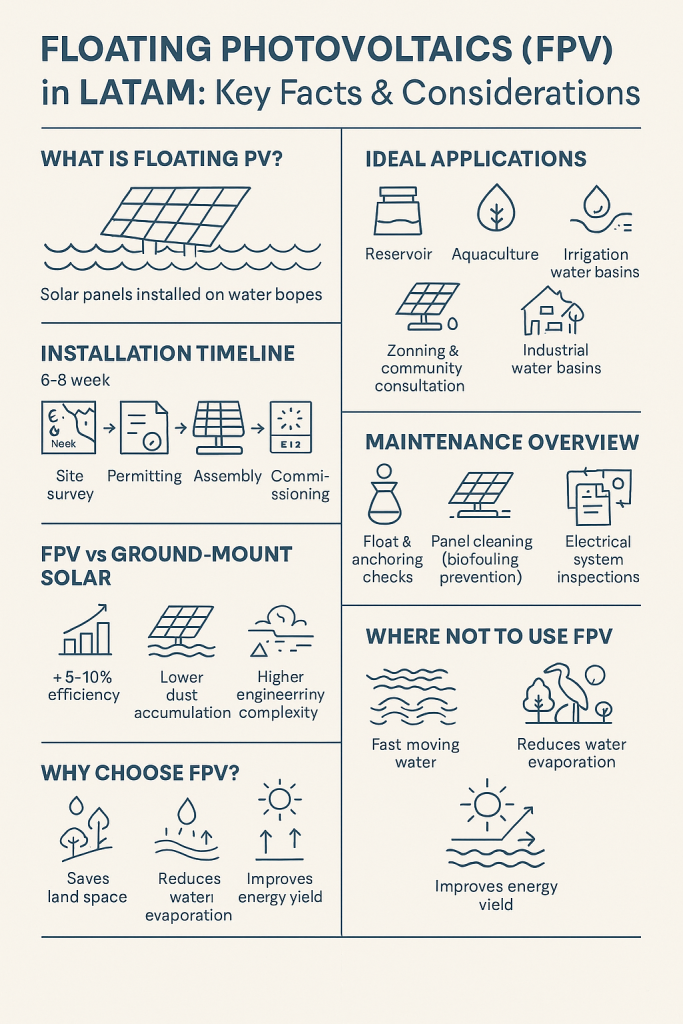
Installation timelines vary by project size and site complexity. For example, a 5 MW Neptune FPV system typically takes about 6–8 weeks from site preparation to commissioning. This timeline includes float assembly, module mounting, electrical connections, and system testing. Factors like weather and permitting can impact schedules, so early planning is essential.
Environmental Permits in LATAM: Navigating the Regulatory Landscape
In LATAM, FPV projects often face a complex permitting process that varies by country and sometimes even by region within a country. Key permits typically required include:
- Water Use or Concession Permits: Many FPV sites use reservoirs or irrigation ponds, requiring official authorization for altering water surfaces or usage rights. Countries like Colombia and Mexico strictly regulate water bodies under their Ministry of Environment or Water Authorities.
- Environmental Impact Assessments (EIA): Projects exceeding certain capacity thresholds or impacting protected water bodies may require a detailed EIA, which can take several months. These assessments analyze potential effects on aquatic ecosystems, water quality, and local wildlife.
- Land Use and Zoning Approvals: Even though FPV reduces land footprint, installation near protected areas or urban zones may require zoning approvals or community consultations.
- Local Community and Stakeholder Engagement: Engaging with indigenous or local communities is increasingly important, especially where water sources are culturally significant.
Navigating these permits is often the bottleneck for FPV in LATAM. Eco Green Energy collaborates closely with local legal and environmental consultants to streamline the process, leveraging experience from multiple successful deployments to anticipate and mitigate delays.
Maintenance Logistics: Ensuring Reliability Over Water
Maintaining FPV involves more than just cleaning panels:
- Float and Anchoring Integrity: Regular checks ensure that HDPE floats and mooring cables remain secure, especially after storms or seasonal water level changes. Degraded anchoring can cause system displacement or damage.
- Electrical Systems: Moisture and humidity demand rigorous inspection of cables, connectors, and junction boxes to prevent corrosion or short circuits.
- Panel Cleaning: While FPV benefits from lower dust accumulation compared to land systems, biofouling (algae buildup) on floats or panels can still occur, requiring periodic cleaning.
- Structural Maintenance: Aluminum framing and mounting hardware must be checked for corrosion and mechanical stress.
- Remote Monitoring: Neptune systems integrate advanced IoT sensors and cloud monitoring platforms, enabling real-time performance tracking, fault detection, and predictive maintenance alerts. This reduces manual inspection frequency by up to 50%, saving operational costs and minimizing downtime.
How Does FPV Compare Technically to Traditional Solar?
While the energy generation principle is the same, FPV behaves differently than traditional ground-mount or rooftop systems in key areas:
- Cooling Effect: The water’s surface helps keep modules at lower operating temperatures, improving energy yield by approximately 5–10%, according to a 2020 study by the National Renewable Energy Laboratory (NREL).
- Soiling Rate: Dust accumulation is generally lower over water, reducing cleaning frequency by up to 30% compared to ground-based systems.
- Design Complexity: Structural design must account for wind, wave dynamics, and variable water levels, which increases engineering requirements.
- Electrical Safety: FPV systems require strict waterproofing, grounding, and insulation standards due to the humid environment.
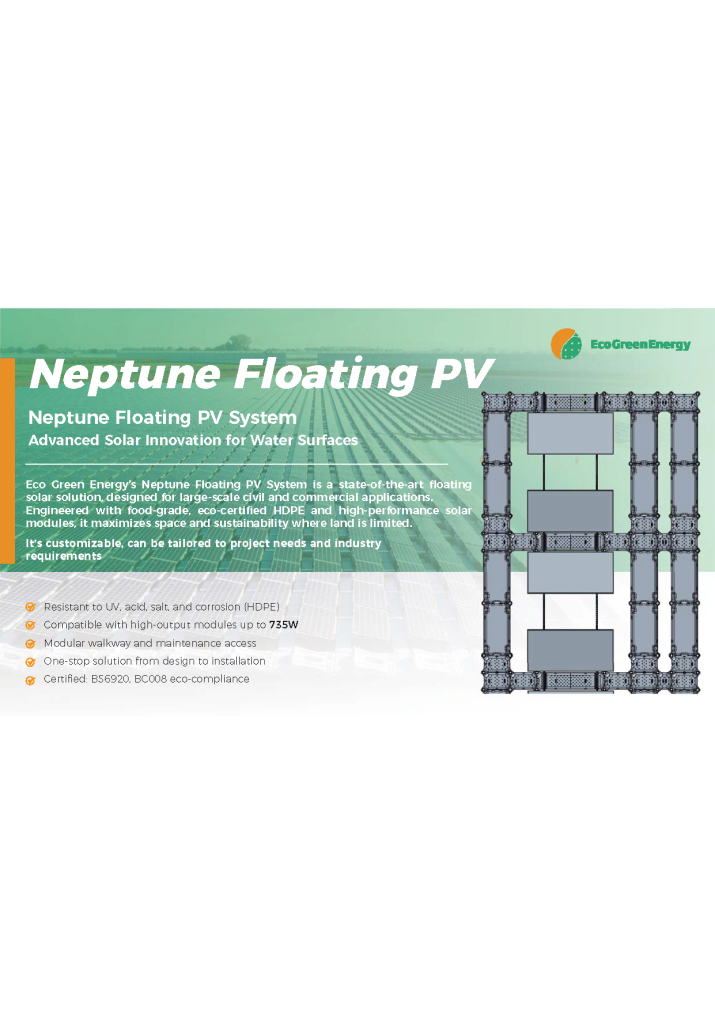
Our Neptune FPV system addresses these variables with corrosion-resistant HDPE floats, anodized aluminum frames, and a walkable design that eases maintenance access.
What About Cost?
One of the most frequent questions we receive from industrial clients and EPCs is whether FPV is cost-competitive.
In many cases, FPV systems come with a higher upfront cost compared to land-based PV, due to floats, anchoring equipment, and site-specific engineering. On average, CAPEX can be 10–20% higher. However, this is often offset by:
- Avoidance of land acquisition or clearance costs
- Increased energy yield from the cooling effect
- Strategic placement near energy-intensive water users
The long-term ROI remains strong, especially when FPV is used to directly support on-site consumption or replace diesel generation. For water-intensive industries like agriculture or aquaculture, FPV offers dual resource optimization: energy and water.
Who Stands to Benefit the Most?
FPV systems are not limited to utility-scale projects. In fact, we see the most promising growth in commercial and industrial sectors, where energy autonomy and land-use efficiency are key priorities. Typical clients include:
- Agricultural operators with seasonal irrigation needs
- Aquaculture businesses in tropical climates
- Industrial plants with water retention basins
- Water utilities looking to reduce operational costs and emissions
In regions like LATAM, where solar radiation is high and many industries operate near water sources, the application potential is significant.
LATAM Outlook: Local Momentum for Floating Solar
In our recent interview with Energía Estratégica, we outlined our plan to develop 100 MW of floating PV capacity across Latin America. Our current focus is on Ecuador, Colombia, and Mexico, where ideal solar conditions, growing industrial demand, and the availability of artificial reservoirs create fertile ground for growth.
As our LATAM representative shared:
“Clients are becoming more open to alternative solar applications. They want solutions that are efficient, sustainable, and don’t interfere with primary land use. FPV allows them to reach these goals without compromising their operations.”
This message resonates strongly with industrial and agricultural stakeholders who are balancing environmental performance with operational viability. We believe the region is entering a new phase of solar deployment, and FPV will play a strategic role.
Of course, our goal is to expand to more markets, and currently, APAC has a high potential and need for floating PV systems. Indonesia and Singapore specifically are two of the countries we’ve had our biggest discussions with, while within Intersolar, strong interest was displayed by clients from Germany and the Netherlands.
Final Considerations: What Should You Know Before Starting?
Floating PV is not a drop-in replacement for ground-mounted solar. Site analysis is critical. Factors like water depth, wave height, anchoring feasibility, and local regulations must be evaluated early. Additionally, not all water bodies are permitted for solar installations, particularly those supplying drinking water.
Eco Green Energy provides full technical support throughout this process, from initial site survey to electrical configuration and after-sales maintenance. We debuted our FPV system along with a comprehensive line of other products for all industries, such as Agri PV and BESS, at Intersolar Europe 2025!
Conclusion: FPV Is a Strategic Investment, Not Just an Innovation
Floating PV is no longer experimental. It’s a proven, practical solution that fits real-world constraints and delivers measurable impact. For clients with access to water surfaces and a need for on-site clean energy, FPV can outperform traditional systems both technically and economically.
Our Neptune system reflects our belief in practical innovation — solar that adapts to new terrains, new industries, and new energy realities.
As LATAM and other regions advance their energy transitions, Floating PV will increasingly move from the margins to the mainstream. And Eco Green Energy will continue to lead that charge, one project at a time.
Subscribe to our LinkedIn Newsletter for more insights, industry news, and updates from Eco Green Energy. Click here to download our Neptune Floating PV datasheet


